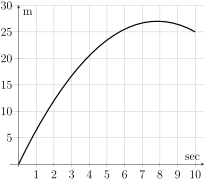
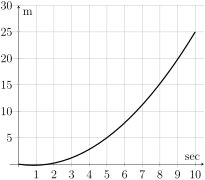
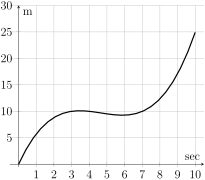
In a three-legged race, people compete in teams of two. In each team, one person’s left leg is tied to the other person’s right leg. All teams run from the start to the finish, competing to be the first team across the finish line.
Parabola facing down. Increases from \((0,0)\) to about \((8,27)\text{,}\) then decreases to \((10,25)\text{.}\) The horizontal axis is labeled seconds and the vertical axis is labeled meters.
Graph starts at \((0,0)\) and increases to \((10,25)\text{.}\) It initially increases slowly, then speeds up. The horizontal axis is labeled seconds and the vertical axis is labeled meters.
Graph increases from \((0,0)\) to \((3,10)\text{,}\) decreases to \((6,9)\text{,}\) then increases again to \((10,25)\text{.}\) The horizontal axis is labeled seconds and the vertical axis is labeled meters.
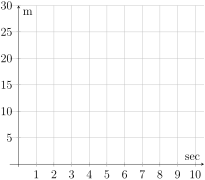
Team D started the race at the same time as the other teams, finished in 10 seconds, and ran forward toward the finish line at a consistent pace for the entire race. Sketch Team D’s progress on the axis below. How fast did Team D run?
Blank axes. The horizontal axis is labeled seconds and ranges from 0 to 10. The vertical axis is labeled meters and ranges from 0 to 30.
Find the average rates of change of Team A during the three-legged race over the intervals 0 to 10 sec, 0 to 3 sec, 3 to 6 sec, 7 to 8 sec, and 8 to 10 sec.
Bailee thinks she is spending too much time on her smartphone, and has been trying to cut back. The table below shows how many hours she spent on her phone every day over the past week, where day 0 is the start of her intentional effort to reduce her smartphone usage.
Bailee forgot to keep track of how many hours she spent on her phone on days 5 and 6. Use your average rate of change to estimate her smartphone usage on these two days.
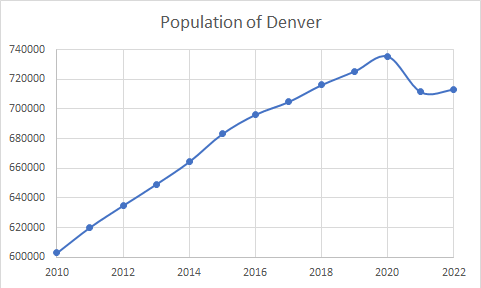
Between 2010 and 2020, Denver’s population increased at a fairly steady rate from about 603,000 to 735,000. Population estimates are 620,000 in 2011, 635,000 in 2012, 649,000 in 2013, 665,000 in 2014, 683,000 in 2015, 696,000 in 2016, 705,000 in 2017, 716,000 in 2018, and 726,000 in 2019. Population dropped to about 711,000 in 2021, and then rose slightly to 713,000 in 2022.
Find three different estimates for the rate of change of Denver’s population between 2010 and 2020. Do your estimates support the rate of change being fairly steady during this time period?
Using a rate of change to estimate values outside of the data range available to us is called extrapolation. Use your response to the previous question to explain why extrapolation can be dangerous.