These activities will help you review some graphing skills that you will need in many future lessons. You will also practice find average rates of change, an essential skill for this lesson.
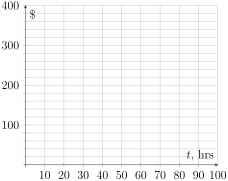
If we’re given the coordinates of a point, then we graph the point by going over to the first coordinate on the horizontal axis, and then up or down to the second number on the vertical axis. Graph the points \((10,100)\text{,}\)\((25,200)\text{.}\) You’ll need to estimate the location of 25 on the horizontal axis.
describes the point \((25,200)\) on our graph. We know that 25 hours has to be the first/horizontal coordinate because of the labeling of the axes in our graph.
We will sometimes be given points in a data table. Tables might be organized vertically, with named columns, or horizontally, with named rows. Look for the row and column names to find the horizontal and vertical coordinates of the points. Here are the points we’ve already graphed, arranged in a table in two different ways.
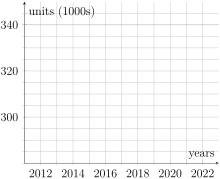
Graph the points and connect them. You’ll need to estimate the exact location of each dot! Why does it make sense to connect the points in this context?
Notice that this data set says that it is giving us “Number of Housing Units (1000s).” This is common when working with large numbers. To find the number of housing units, we need to multiply the given values by 1000. So, for example, there were 284,000 housing units in 2011. How many housing units were there in 2022?
We learned in Section 2.2 how to find average rates of change. A useful writing convention to be aware of is that when we say “the average rate of change IN (some quantity)”, then (some quantity) is the output quantity and goes in the numerator of the fraction. Find each of the following:
You’ll need to be able to do the following things for this lesson. Rate how confident you are on a scale of 1 - 5 (1 = not confident and 5 = very confident).