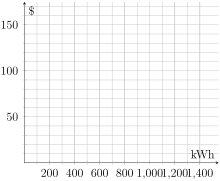
Sketch a graph that shows the relationship between kWh used in the summer and a customer’s bill. Hint: Start by graphing the three points you found in parts (a) - (c)!
A mathematical model that has a constant rate of change is called linear model. The rate of change of a linear model is called its slope. Linear models are functions, so we will sometimes use function notation when working with them.
Decide whether each of the three data sets has a linear model. Explain your answers in words. If a data set does define a linear model, find its slope.
The vertical intercept of a mathematical model is the value where the graph crosses the vertical axis. It is also called the initial value because it is the output when the input is 0. What is the vertical intercept of your graph in Activity 3.2.1 part (e)?
Reminder: \(B(k)\) is read “\(B\) of \(k\)” and is NOT multiplication; \(B\) is the name of the function, \(k\) is the input, and \(B(k)\) all together is the output. In this context, \(k\) is the kWh of energy that Theo used, and \(B(k)\) is the amount of money he owes.
Suppose a family makes a quarterly (3-month) budget to plan for upcoming expenses. This family estimates they will use an average of 1000 kWh per month in July, August and September. How much money must the family set aside in the budget so that they will be able to pay for the electricity they will use during the three-month period? Round to the nearest dollar, since budgets are only estimates.
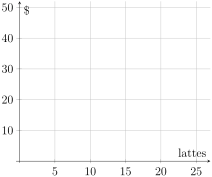
A local coffee shop offers a coffee card that you can preload with any amount of money and use like a debit card each day to purchase coffee. At the beginning of the month (when they get their paycheck), Arlo loads it with $50. Their favorite small soy latte costs $2.63.
Let \(A(n)\) be the amount Arlo has left on their coffee card and \(n\) be the number of latte’s they’ve purchased. Find a formula for the linear model relating \(A(n)\) and \(n\text{.}\)
A horizontal intercept of a mathematical model is the value where the graph crosses the horizontal axis. It tells us the input value that has an output value of 0. What is the horizontal intercept of this model?
Will Arlo’s card last until the end of the month? If so, how much is left? If not, how many days will it last? (Note: There are about 22 weekdays in a month.)
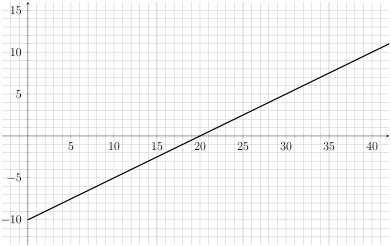
As an example, suppose a company offered to send 30 greeting cards to a child to sell to relatives, friends, and neighbors. The child was to sell them for \(m\) dollars each, and had to send \(b\) dollars back to the company. Here is a graph of a linear model representing the situation. The input (horizontal value) represents the number of cards sold, and the output (vertical value) represents the child’s profit in dollars.
The horizontal axis is ranges from -3 to 42. The vertical axis is ranges from -13 to 16. The graph shows a line with vertical intercept -10 and horizontal intercept 20.
Find a formula for \(P(n)\text{,}\) the child’s profit, in terms of \(n\text{,}\) the number of comics they sell. Hint: What information do you need to find a formula for a linear model?
Data plans for cell phone plans can be purchased in two different ways. One is an unlimited data plan where the customer pays a set monthly fee for unlimited data. The other is a per-gigabyte (GB) pricing service where the customer pays a set monthly fee plus a specified amount for each GB. The GBs are not prorated (that means it doesn’t matter if the customer uses 0.001 GB or 1 GB, they must still pay for the entire 1 GB). The cost of the phone itself and other fees are the same amount under each plan.
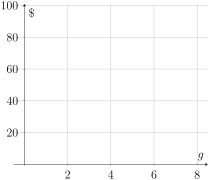
Let \(P(g)\) be the monthly cost for the per-GB pricing plan and \(g\) be the number of gigabytes used. Create the linear model for \(P(g)\) in terms of \(g\text{.}\)
Let \(U(g)\) be the monthly cost for the unlimited pricing plan and \(g\) be the number of gigabytes used. Create the linear model for \(U(g)\) in terms of \(g\text{.}\)
Under what conditions is the per-GB plan less expensive? Under what conditions is the unlimited plan less expensive? Explain in words how you found your answers.