When creating rankings like the one above, we first need to decide what factors (variables) will contribute to the overall ranking. Then, we need to decide how those factors can be measured (quantified). Finally, we need a formula that combines all of them into one overall score.
In your group, agree on a topic that interests everyone (or most of you!), and try to come up with a strategy to create a ranking system related to that topic. After agreeing on a topic, think about:
Every year, U.S. News & World Report publishes a list of the best colleges in the United States. Colleges on the list are ranked based on many different factors, such as first-year student retention, graduation rates, and faculty strength.
Using what you know about how U.S. News ranks colleges, discuss what things you might include in your decision in choosing a college. That is, what factors would be important to your decision?
A mathematical model is a description of a system, or situation, using mathematical concepts, language, and numbers. People often use variables to help create mathematical models. Mathematical models can be represented as equations, tables, graphs, or descriptions in words.
Let’s look at a mathematical model for ranking community colleges that combines variables to give us one number for each community college. The Aspen Institute awards the Aspen Prize every other year. The award “honors those institutions that strive for and achieve exceptional levels of success for all students, while they are in college and after they graduate.” 3
In addition to the prestige of winning this award, the winning college also receives a $1 million cash prize. To determine the 150 finalists for the award, the Aspen Institute collects information from 1000 community colleges related to the following variables:
Performance - The performance score measures student success in persistence, degrees awarded, completion, and transfer;
Minority Achievement and Family Income - The minority achievement score and family income score measure equitable outcomes for students of all racial/ethnic and socioeconomic backgrounds.
Look at the scores in the table below for four community colleges. Which school do you think is the “best?” Why? (Hint: What data are you focusing on in the table?)
Use this equation to calculate the overall score for each of the schools and enter it into the table above. According to the overall score you calculated, which school is best?
found that the proportion of Americans that are severely obese was increasing. How do you think the researchers in this study obtained information about these variables? Imagine yourselves as the researchers. You will want a large, varied sample, and you have limited funds. What would be a good way to get people’s height and weight from diverse U.S. locations?
The table below lists known heights and weights of several current and former athletes. Calculate the BMI for each of the athletes. Use the fact that one inch is 0.0254 meters and one pound is about 0.454 kilograms.
Most of the mathematical models that we’ll explore in this class are functions. A function is a special type of mathematical model that matches each value of its input quantity to exactly one value of its output quantity. Mathematicians use a special notation for functions, \(f(x)\text{,}\) which is read “\(f\) of \(x\)”. It has three parts:
We can use the table to evaluate expressions in function notation. For example, if we’re asked “Evaluate \(P(2018)\)”, the table tells us the answer is \(35\text{.}\)
We can also use the table to solve equations in function notation. For example, if we’re asked “Solve the equation \(P(y) = 17\)”, the answer is \(y = 2014\text{,}\) since that’s the year in which \(17%\) of US adults used Instagram, according to the table.
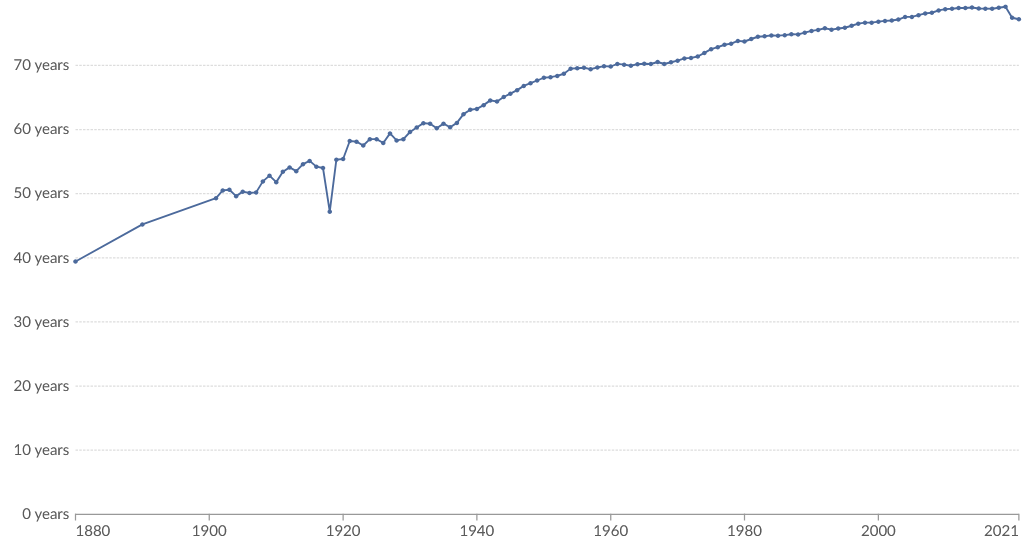
We can also use function notation with graphs. In the graph below, let \(y\) be the year, and \(L(t)\) be the life expetancy at birth in year \(y\text{.}\) 6
“Data Page: Life expectancy at birth”, part of the following publication: Saloni Dattani, Lucas Rodés-Guirao, Hannah Ritchie, Esteban Ortiz-Ospina and Max Roser (2023) - “Life Expectancy”. Data adapted from Human Mortality Database, United Nations, Zijdeman et al., James C. Riley. Retrieved from https://ourworldindata.org/grapher/life-expectancy [online resource], November 25, 2024.
The velocity, in feet per second, of a car that slammed on its brakes can be determined based on the length of the skid marks that its tires left on the ground. Suppose that on a particular surface, this relationship is given by